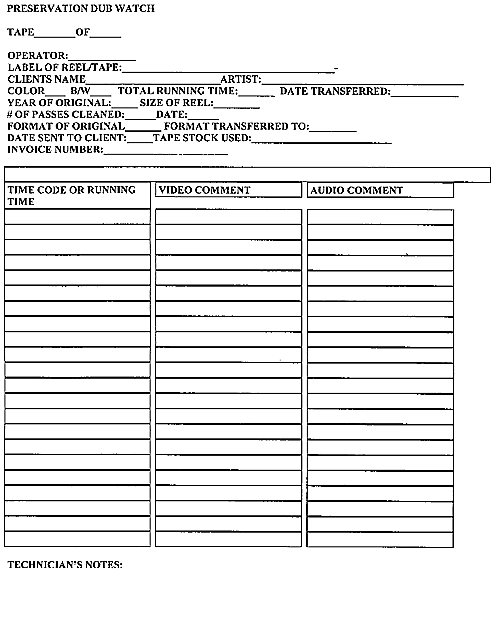
Appendices - Dub Sheet
Submit a change or correction
Last modified 15 September 2026
Related records
- Appendices - Block Diagrams of BAVC's Remastering Facility Preservation
Reel to Real: A Case Study of BAVC's Remastering Model: contents
- Reel to Real: A Case Study of BAVC's Remastering Model Preservation
Table of Contents Acknowledgements Introduction Background on the BAVC Model Elements of the Remastering Process Tape Preparation and Cleaning Origination Formats and Machines Preservation Formats Components of the Remastering System Care of the Facility Documentation of Cleaning and Remastering Ope…
- Operating a Remastering Facility Preservation
BAVC operated a remastering center transferring obsolete formats such as 1/2" open-reel tape; transfers involved cleaning machines, playback decks and manual procedures that could take several hours and required trained technicians (early pay noted as $15/hour) and a 20% income reserve for maintenance. The center secured preservation funding and organized Playback 96: Video Roundtable, partnered with NIPAD to train dance companies, and sought support from sources such as the NEA Heritage and Preservation Program. Staff proposed research into tape baking, integrated cleaning/playback machines, magnetic transfer methods, uncompressed nonlinear workflows (Avid Symphony/D1), archival data formats (DLT/D1) and collaboration with WGBH's Universal Preservation Format Initiative.
- Introduction Preservation
Sherry Miller Hocking's February 2002 introduction surveys efforts to preserve independent videotape and electronic media from the 1960s to 2002; it documents institutions and initiatives including the NEA and AFI, F/TAAC/AMIA, MoMA's 1991 symposium, Playback 1996, BAVC's remastering facility (1995), IMAP (1999), TechArcheology (2000), Preserving the Immaterial (2001) and the Looking Back/Looking Forward symposium (May 31–June 1, 2002). It identifies technical and organizational problems—videotape deterioration, obsolete equipment, dispersed collections and lack of a union catalog—and lists recommended actions such as compatible cataloging, remastering research and facilities, public and educational programs, and broader funding and coalitions.
- Acknowledgements Preservation
Reel to Real: A Case Study of BAVC's Remastering Model: contents Photos were taken by Luke Hones, except where captioned. Special thanks to: The Electronic Media and Film Program at the New York State Council on the Arts for their support of this manuscript. Charles Bensinger for permission to repro…
- Background on the BAVC Model Preservation
BAVC identified videotape deterioration and equipment obsolescence in 1992 and proceeded to develop a model remastering center, beginning remastering of skip-field and EIAJ 1/2" open reel formats in 1994; the author served as BAVC Director of Research and Development and Sally Jo Fifer was Executive Director. BAVC secured an NEA Challenge Grant in 1993 and matching support from the Andy Warhol Foundation, the San Francisco Foundation, NAMID and the California Arts Council, and acquired decks from Intermedia Arts in exchange for transfers to the Minnesota Historical Society. Staff including Debra Finucane and Grace Lan established documentation and workflow; technicians Jonathan Selsey and Heather Weaver noted a lack of ongoing R&D; technical sources cited include Ampex, 3M, Sony, Charles Bensinger's Video Guide, NASA Publication 1052 and Merlin Engineering's Ken Zhin.