Collections
7 records
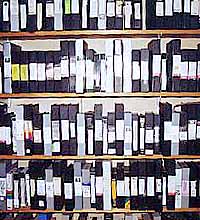
Thousands of original videotapes created by pioneering individuals and organizations are held by organizations throughout the US. The works offer many possibilities for research, scholarship, education and public programming in the arts, social sciences and humanities. This historical and cultural legacy remains largely unknown outside the media field. Access to early video work remains limited, and the works are rarely programmed outside of major arts institutions.
The works in many collections are in need of cataloging and preservation, before efforts can be made to make them publicly accessible.
Distribution at Galleries, Museums, and Media Centers
Survey of videotape distribution through U.S. museums, gallery dealers and media centers; contributors include curators and distributors at Whitney, Everson, Berkeley University Art Museum, MoMA, Castelli/Sonnabend, Electronic Arts Intermix, Global Village, The Kitchen and Synapse. Museums package traveling video shows and charge artist fees; distributors and media centers lease or sell tapes to institutions. Betamax/VHS, cable and broadcast are discussed as emerging markets; notable projects include the Whitney's Introduction to Video for the AFA catalog, Everson's Video Anthology, Global Village's Giving Birth and Synapse's planned paid distribution beginning January 1979.
Early Distributors of Video Art: Articles
Bibliographic listing of early video-art distribution articles and directories by specialist organizations and periodicals. Association for Independent Film and Videomakers published Plugging into the Video Circuit in The Independent (June 1983); Bay Area Video Coalition published Video Distributors in Video Networks (Oct 1983) and produced the Video Networks National Video Distributor Directory, an annual beginning about 1986 with extensive distributor listings and profiles. National Video Resources' NVR Reports ran multiple pieces on home-video marketing, education and digital distribution (Issues 1–17, 1990–1995); Videography ran distributor profiles including Castelli/Sonnabend Tape and Film (Jan 1977) and Museum of Modern Art (Apr 1983, Aug 1984).
From the Distribution Religion - Notes on the Aesthetic of Copying an Image Processor
Phil Morton, identified here as the first copier of an Image Processor, offers practical notes for future copiers; he endorses faithful copying of Dan Sandin's Image Processor (I-P) and regards copying as a valid method for learning. He warns against unauthorized modifications that may render replicas incompatible with Sandin's evolutionary I-P design and advises consulting Dan and $PENDing his time for fixes, suggesting a year of copying practice before building an Image Processor.
Introduction to The 5th International Video Exchange Directory
The Satellite Video Exchange Society of Vancouver published an annual directory listing about 500 individuals and groups involved with small-format video; the catalog was organized internationally by region, compiled from contributor information, initially distributed free and, by 1979, subject to a minimal charge for non-listed parties. The society also published Video Guide and maintained the Video Inn library; editorial credits include Andy Harvey, Shawn Preus and Paul Wong (1977) and Mary Ready (1979), with an introduction by Paul Wong. The text outlines the society's rationale for non-commercial videotape exchange, types of exchange, copyright limitations and free circulation practices; Video Inn has 1/2" European Sony VTRs and has engaged in video exchange since 1973.
Report on the Everson Museum Video Conference. April 11 and 18, 1974
Synapse Distribution
Synapse has entered the distribution business and is experimenting; it permitted cable systems such as Manhattan Cable to show its tapes free temporarily but will limit future free arrangements to venues deemed prestigious for the artist and Synapse, and is working with PBS, regional networks and toward national networks. PBS station WXXI in Rochester ran a twenty-week series of half-hour works last summer and wants to rerun them; Synapse proposes fees of $50 per week per tape for cable and about $190 per tape for public television plus dubbing, with 50 to 75 percent of fees to artists. It plans closed-circuit distribution to libraries, colleges and museums and to be on a paying basis by January 1979.
Video Art Distribution
In 1983, according to a survey conducted by the Media Alliance, the seven top video art distributors in America accrued less than $300,000 in revenues. The figure is shamefully low - $100,000 less than the average budget for a single half-hour broadcast television show. The total is minute even by a…
See also
- Texts - Read texts from the biblio database describing the evolution of distribution strategies and the changing structures and methodologies devised by individuals and groups for making the work available
- Collections & Distribution links - Organizations maintaining public collections or providing distribution of videotapes, and which emphasize early historical works are listed here