Tools
92 records
Media makers have faced many technological challenges as the field has evolved. The early portable video technology introduced in the 1960s offered a very limited control over the recording and playback of images. When introduced, editing systems were expensive and the process laborious. Tools providing “special effects” such as colorization, superimposition and the like, were available only in expensive broadcast studio situations.
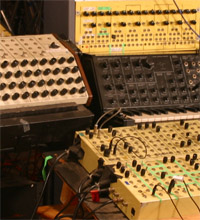
Artists working in this time-based medium wanted tools which specifically addressed the processes of electronic image construction. Through collaborative strategies among artists, tool designers and engineers, existing commercial equipment was modified, and new imaging instruments were created. These hand-built machines offered imaging techniques not seen before, allowing artists to explore the essential inherent properties of the medium.
1" reel to reel videotape recorders
International Video Corporation flourished from about 1967 into the late 1980s; it manufactured dozens of models of VTRs, cameras, film chains, switchers and other video equipment for the low end broadcast and high end industrial markets. The IVC 825 is a basic 1" reel to reel record/play VTR with a capstan servo; the IVC 850 is an IVC 825 with the addition of an electronic editor. The IVC 860 is very similar to the IVC 850; it is a 1" reel to reel color editor and was able to perform both assemble and insert edits.
A Building Block Approach to Color Graphics
Excerpt documents the design rationale and implementation of the CAT-100/C modular video-graphics system; it describes a two-board S-100 bus implementation with a 32K dedicated frame buffer (expandable to 256K), a real-time analog-to-digital input (4-bit), D/A output and NTSC color generation, serial data paths and three external video streams, and facilities for lightpen input and photographic triggering. It details buffer formats and page/window addressing, two-port buffer timing guaranteeing clean display, text mode capacity and clock options, and palette and control-register functions for image and color handling.
A Conversation on Electronics and Black TV with Aldo Tambellini
A recorded conversation between artist Aldo Tambellini and engineers Charles Bruner, Ronald Reisdorf, John San Pietro and Kenneth Wise about electronic media and future aesthetics; participants discuss television, videotape recorders and monitors, cathode-ray tube walls, computers, lasers, holograms and three-dimensional immersive spaces. Tambellini proposes an art of Black as a moving, temporary force controlled by the artist's mind; Wise and Bruner describe domestic and architectural applications while Reisdorf and San Pietro emphasize collaboration between artist and engineer and the transmission of electronic image forms. The discussion links electronic light and energy to future social and spatial transformations.
Akai VT 150
Technical data sheet for the AKAI VT-150 color video tape recording system; describes a lightweight VTR and multi-purpose color camera with Automatic Editing Control, Stop Motion (with jeeped monitor), Sound Dubbing and Two-Head Helical Scan recording, complete system weight 22 lb and 26 minutes recording per 5" reel (up to 40 minutes on batteries). The camera is NTSC frequency-multiplex with a 2/3" vidicon luminance tube and Akai color dissector, 6X (12.5–75mm) F2 zoom and 525-line scanning; CCU-150 supplies NTSC video/audio outputs and 120V AC power.
Akai VT 100 and Akai VTS-110 DX Descriptions
Akai Portable Video Tape Recorders The Akai VT 100 was a black and white portable video system which used ᄐ" tape. Introduced around 1969, the machine could record video using normal audio tape, although the quality was improved when using the Akai's special quarter-inch videotape. From Product Lite…
Ampex Products Chronology
Chronology and product notes compiled by Howard Sanner (Draft: 29 Oct 1995; Rev. 4 Nov 1999) document Ampex professional audio and video equipment, principally drawing on the Ampex Fact Book (1970). Entries describe machines such as the Ampex 7500 (first color-capable Type A VTR with up to 4.2 MHz bandwidth), the VP-4900 (closed-circuit player for education, industry, government and medicine), and the VR-660; Jim Wheeler recounts a 1964 in-flight video project for Continental/TWA and U.S. Air Force VR-660 installations on B-52s during the Vietnam War that recorded up to six hours. The file includes production dates, model developments, awards, and discussions of specific audio recorder designs and performance.
An Introduction to Portable Video Systems
Manual excerpt from the Experimental Television Center Access Program, also distributed via the Center's Workshop Program, the Cinema Department at Binghamton University, Media Study/Buffalo and other state media arts centers; it provides an introduction to principles and operation of 1/2" portable video systems (portapacks). It describes system components and controls (camera with vidicon tube and C‑mount zoom lens, microphone, deck/videotape recorder with video/audio/control heads and RF output, AC adapter, internal gel cell and external nicad batteries, television receiver), signal flow and helical-scan recording, tape format limits (1/2" reel-to-reel, max 30 minutes), editing by re-recording, video processing tools, exhibition modes and operational precautions.
Cloud-Driven Music: Description of Device and Installation
Press Release for Cloud Machine 1974 Information sheet for Cloud-Driven Music c. 1976 Cloud Music was a mixed media installation developed by David Behrman, Bob Diamond and Robert Watts during 1974-1979. The installation consisted of a black and white camera which was pointed at the sky. A video ana…
Col-R-Tel Converter System
The Model 100-1 Col-R-Tel was a mid-1950s mechanical color-conversion system designed to be placed in front of a ten inch black-and-white television set; a motorized spinning tricolor disc in a large plastic wheel synchronized with an assembly on the back of the TV while a chassis mounted to the rear provided electrical connections inside the set. The converters produced a reasonably good color picture only on very small screens; original cost in 1955 was $150 and the device was featured in Popular Science, October 1955.
Colorizers Come of Age
Overview of video colorization and synthesizers, describing NTSC color theory and the Y-I-Q system and explaining color subcarrier and chrominance bandwidth (color burst 3.58 MHz). Reviews early analog colorizers and raster/video synthesizers and cites devices and practitioners including the Sandin Image Processor, Paik/Abe Synthesizer, Rutt/Etra, EAB Videolab, Colorado Video Corp. and Computer Image Scanimate; outlines the Video Modular System (VMS) colorizer: A/D (four-bit/16 levels, sampled at 14.3 MHz), D/A, RGB encoder, computer interface (Z-80, TRS-80 and others), and modules (8-input/3-output matrix, pattern generator, multiplexer, RGB decoder, frame buffers 390x600x4-bit); lists applications in labs, medicine, industry, security and video art and notes VMS price starting about $2,000.
Computer Animation Systems GRASS and ZGRASS
Dan Sandin arrived at the University of Illinois in 1971 and developed the Sandin Image Processor; Tom DeFanti joined shortly after and developed the Graphics Symbiosis System (GRASS) during his PhD. They formed the Circle Graphics Habitat at the University of Illinois at Chicago Circle, where GRASS ran on hardware including a Vector General CRT, a PDP-11 and the Sandin Image Processor; the system was purchased by the UICC Chemistry Department and received funding from organizations including NSF and the Carnegie Corporation. In 1978 the Z Box project produced ZGRASS, a Z-80 Bally-based 3D system with NTSC output that DeFanti attempted to commercialize through Real Time Design, Inc.; a ZGRASS device was presented at Video History: Making Connections, 1998.
Computer Systems Approach to Video Art
A 1975 proposal to the New York State Council on the Arts and a 1977 report describe a computer-based video synthesis system for synthesizing, processing and controlling video images for artists. The documents list proposed and conventional components including spatial and intensity digitizer, function generator, digital memory, A/D and D/A converters, sync generator with genlock, time-base corrector, chroma keyer, colorizers, keyers and special-effects generators; they define interactive-compositional and automatic-production modes. The system specifies a 1,024-word 16-bit buffer, a DEC LSI-32 microprocessor with Teletype I/O and floppy drives, a 9.7552434 MHz clock phase-locked to a 3.579545 MHz subcarrier, and an X–Y module providing 512 pixels and 18 bits of timing.
See also
- Tools List - a list of texts in the biblio database that provide descriptions of video and audio instruments
- Texts - includes articles, essays, manuals and other writings which offer insights into the desires of the image-makers, and the ways the electronic image was defined. This list is also from the biblio database
- Tools Links - for other web sites on this subject