Groups
105 records
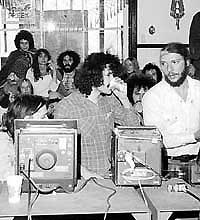
The media field began its evolution in the decade of the 1960s within a rich cultural mix of factors including the introduction of portable videotape technology, the growth of public support for projects in the arts and humanities, and the radical counter-cultural movement. New York State hosted some of the earliest media activity in the United States. There were over thirty media organizations active in the upstate region alone during the period 1968-1980.
The groups operated with a variety of organizational strategies, from individual to collective. Media makers explored video as an art medium and as a tool for social and cultural change, producing documentaries, narratives, conceptual, and image-processed work presented on cable and television, in regional and community venues and in art contexts. For profiles of organizations active during the evolution of the field, browse the groups below.
A Description of Media Study/Buffalo Film/Imagemaking Workshop
Founded by Dr. Gerald O'Grady. "Literacy's been with us now since the nineteenth century and is pretty much accepted to be a universal thrust. My own theory is that we should move towards what I call 'mediacy'. It's a political issue; one cannot participate in society unless one can use the channels…
A Squeaky History
Squeaky Wheel (also Buffalo Media Resources) formed from community meetings in 1985–87 following the 1985 closure of Media Study/Buffalo; Julie Zando was appointed director and founding members included Tony Conrad and Chris Hill. The organization operated equipment access (SWAP), workshops, internships, a weekly public-access show (Axlegrease) and the seasonal publication The Squealer (first Upstate issue 1988); it obtained NYSCA funding (initial $22,000 in 1986) and additional support from the Buffalo Foundation, Wendt Foundation, Benton Foundation and NEA to purchase equipment including a V5000 camcorder, Hi-8 gear and Macintosh computers. Squeaky Wheel occupied storefronts at 585 Potomac Avenue, 372 Connecticut Street and 175 Elmwood Avenue and organized events such as MediaBuff (1988), a Native American Film/Video Festival (1992) and a Digital Art Interactive show (1993).
Albany Public Library: Video and the Library (1977)
Excerpt from Videoscope 1977 reports that the Albany Public Library, central library of the Upper Hudson Library Federation of 25 libraries, planned a live public access studio to cablecast to 25,000 local subscribers; Bob Katz, APL Media Librarian, expected the Albany Community Video Project to produce most programming while using library facilities. The library acquired video equipment since 1970 (first portapak via LSCA) and received NYSCA support; LSCA-funded Adult Independent Learner Project will provide playback units. Katz considered token studio fees, noted staffing and content controversies, and hired two CETA workers to research cable and survey viewers while canvassing funding and other libraries.
Amazing Grace Media: Overview from the Dumping Place (c. 1973)
Bearsville group producing video, film and graphics; members met through the April Video Conference in New Jersey and at Republican and Democratic conventions covered by TVTV and the Women's Video News Service. Tapes listed include Clear Light (colorized video feedback), TVTV - Four More Years, Women's Video News Service - Another Look - The Democratic Convention, Dance Therapy (Lijan Espanak), The Maine Tapes, Barge Tapes (life on the Hudson River), Viet Nam Veterans Against the War and the Gainesville Conspiracy, Ex Attica Conversations (Al Cruz and James Boyde), tapes from Japan and Formosa, University Settlement Workshop material, and Miss USA Pageant '72. Excerpts appear in Dumping Place, Vol. 2, published by April Video.
An Open Letter from the Media Equipment Pool
Videofreex proposed the Mediabus to the New York State Council on the Arts to travel the state introducing people to video; the Council expanded the idea into regional equipment pools and in June 1971 awarded a grant, with the Rochester Museum and Science Center sponsoring the Mediabus and providing a house's first floor for a Rochester Media Equipment Pool. The Equipment Pool acquired hardware and people who could use and teach it (software), ran workshops and short-term loans for documentation, instruction, drama and abstract electronic feedback. The group articulated an ethic of television emphasizing producer control, consent and immediate playback, and assigned legal liability for cable programming to individual producers to guard against broadcast-style censorship.
Anthology Film Archives
Anthology Film Archives opened at the end of 1970 (manifesto dated December 1, 1970) and originated from initiatives by Jonas Mekas and a 1969 plan involving Jerome Hill, P. Adams Sitney, Peter Kubelka and Stan Brakhage; a Film Selection Committee was formed to assemble the Essential Cinema Repertory. It first screened at Joseph Papp's Public Theater, relocated to 80 Wooster Street, and in 1979 acquired Manhattan's Second Avenue Courthouse, adapted by Raimund Abraham and Kevin Bone to house theaters, a reference library and a preservation department. An Independent Film Preservation program established in 1972 has preserved hundreds of films and the Archives holds more than 4,000 titles; Anthology has published works including Film Culture Reader.
Artists Television Network
http://www.lib.uiowa.edu/spec-coll/ltfs/atn.htm In the 1960s, New York City's SoHo district had more video artists per square block than the rest of the country put together. In 1976 exhibition facilities like the Kitchen, Global Village, and Anthology Film Archives joined with a number of individua…
Artists TV Lab - Woodstock: Artists TV Lab 1976-1977
Artists TV Lab began as a project of Woodstock Community Video in Woodstock; Gary Hill served as coordinator for visiting artists. After the Lab moved to Rhinebeck, the program discontinued visiting artists and instead had founding members as artists in residence. The record directs readers to Woodstock Community Video for detailed information about the program's founding.
Association of Video and Filmmakers: The Fab Formation (of a Media Arts Organization)
The Association of Independent Video and Filmmakers (AIVF) formed in the mid-1970s around organizers including John Culkin and founding board member and first president Ed Lynch; early activity comprised screenings, workshops and advocacy, notably a late-1974 Fifth Avenue Cinema series and a national campaign that defeated an AFI federal funding bill. AIVF established ICAP and in 1975 incorporated the Foundation for Independent Video and Film (FIVF) to dispense grants; it administered CETA funds beginning in 1977 and a NEA-funded Short Film Showcase, grew from 99 Prince Street to 625 Broadway, and published The Independent.
Binghamton University - Cinema Department & Artists Lab at School for Advanced Technology, (1977, 1980, 1983, 1998)
Cinema Department Pamela Susan Hawkins, 1998 The Electronic Gallery Exhibitions 1980, 1983 Cinema Department Program & Relationship with Experimental Television Center Survey of Film/Television/Video/Still Photography/Electronic Music Activity at State University of New York Campuses John Minkowsky.…
Bode Sound Company: Brief History (1998)
Harald Bode was an audio tool design engineer born in 1909 in Germany who formed the Bode Sound Company after moving to the Buffalo area in 1961; the company marketed many of his original designs, including the Bode Frequency Shifter and Bode Vocoder. He published both individually and in collaboration with engineers and designers such as Robert Moog, collaborated with Woody and Steina Vasulka on device design and integration, and presented work at the Audio Engineering Society, Media Study/Buffalo and the Experimental Television Center; his tools and devices are found in electronic music studios around the world. Gordon Mumma described Bode as an engineering hero in the development of electronic music instruments.
Brief History of Cornell Cinema
Cornell Cinema, founded in 1970 as a university film society and now a media arts center, programs close to 400 films and videos annually, seven nights a week in the Willard Straight Theatre and hosts visiting filmmakers. Its primary purpose is to expose Ithaca and regional audiences to alternative forms of cinema and alternative voices; its secondary purpose is to provide affordable, second-run commercial entertainment for the Cornell community. It supplements screenings with a media study library, publications and a film collection and offers frequent guest artists and critics; it is a program of the Department of Theatre, Film and Dance and is cosponsored by the Office of the Dean of Students.
See also
- Groups - browse groups here. This is a listing of texts about groups taken from the biblio database.
- Links to organizations - lists groups which provide informational and advocacy services, exhibition opportunities, access to new technologies, funding or offer multi-focus programs.
- NYS Groups Map - for a visual of early New York State groups.