New York State Council on the Arts Annual Report 1970-71
https://arts.ny.gov/sites/default/files/Annual%20Report%201970%20-%2071.pdf
New York State Council on the Arts Annual Report 1970-71 cover
photo: Peter Moore
Eric Salzman’s Feedback: A Total Environment Presentation, produced at Syracuse University and taped by the Educational Television Council of Central New York. “Eric Salzman’s aim is a form of communication in which the recipient ‘feeds back’ what he experiences either overtly or subliminally in a total environment situation. The four-hour extravaganza involved new and old sounds, sights and dancing. Large screens on three sides of the chapel displayed a series of images and designs, each of short duration and sometimes superimposed. Real and seemingly unreal sounds accompanied these visuals. Exotic dancers were scattered at various elevations, and their gyratory inventions were stimulated by ensembles of brass, woodwinds and percussion.” – Harwood Simmons in the (Syracuse) Post-Standard.
photo: Tobe J. Carey
Elementary school filmmaker at The Community in Willow. “something to look at…something to create.”
Photo: Bernard Gotfryd. Albert Maysles, shown here with his brother in New York City, was an active participant in the Film Bureau’s speaker program. “Control… consists of letting it happen. It’s like talking to someone you’re in love with. You reach the point where you’re just listening. It’s as though you were paddling a canoe and then you just let it go on its own. Sort of guide it along but without the paddle.” – Albert Maysles in Production Notes for “Salesman.”
Photo: Carole Crawford. People’s Video Theatre in Chinatown. “to reach out and open circuits of communication.”
This entry is derived from the 1970-71 New York State Council on the Arts Annual report. It contains images related to film and media, funding by the film and television program, and support of media by other programs.
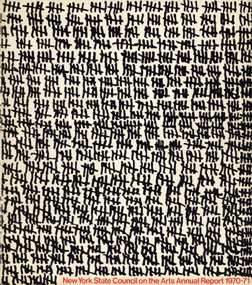
New York State Council on the Arts Annual Report 1970-71 cover
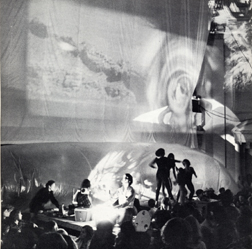
photo: Peter Moore
Eric Salzman's Feedback: A Total Environment Presentation, produced at Syracuse University and taped by the Educational Television Council of Central New York. "Eric Salzman's aim is a form of communication in which the recipient 'feeds back' what he experiences either overtly or subliminally in a total environment situation. The four-hour extravaganza involved new and old sounds, sights and dancing. Large screens on three sides of the chapel displayed a series of images and designs, each of short duration and sometimes superimposed. Real and seemingly unreal sounds accompanied these visuals. Exotic dancers were scattered at various elevations, and their gyratory inventions were stimulated by ensembles of brass, woodwinds and percussion." – Harwood Simmons in the (Syracuse) Post-Standard.
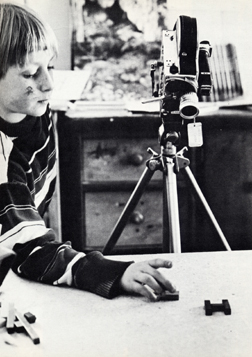
photo: Tobe J. Carey
Elementary school filmmaker at The Community in Willow.
"something to look at…something to create."
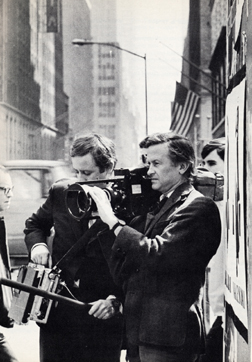
Photo: Bernard Gotfryd
Albert Maysles, wshown here with his brother in New York City, was an active participant in the Film Bureau's speaker program. "Control… consists of letting it happen. It's like talking to someone you're in love with. You reach the point where you're just listening. It's as though you were paddling a canoe and then you just let it go on on its own. Sort of guide it along but without the paddle." – Albert Maysles in Production Notes for "Salesman."
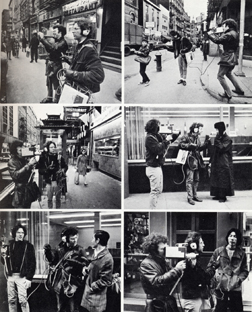
Photo: Carole Crawford
People's Video Theatre in Chinatown. "to reach out and open circuits of communication."
Peter Bradley - Film, TV/Media, Literature Program
Barbara Haspiel - Film Program
Film, TV/Media, Literature
The dramatic expansion of Council support of film, television, and literary projects--the dollar amount has increased from $65,000 in 1969-70 to $1.5 million in 1970-71--is making it possible to reach audiences in numbers undreamed of in previous years. Since, unlike other forms of artistic expression, film, TV programs, videotapes, and published writing have a continuing life of their own, the ultimate number of spectators and participants benefiting from State support in this record budget year is incalculable.
<>
The widespread and still growing interest in filmmaking among young people continued to receive recognition from the Council in 1970-71 through grants to stabilize new film workshops and to continue programs at established filmmaking clubs. To expand audiences for films of all kinds, and to increase the number of locations where the full spectrum of the medium is displayed, the Council gave support to such diverse organizations as the Rochester International Film Festival, the Nassau Library System, and -- in New York City -- the Film Society of Lincoln Center and the Millennium Film Workshop. In all regions of the State, the Council sought to spread the impact of its film grants by working through existing regional organizations, a good example being the grant to the Film Forum of Syracuse which is enabling twelve high schools to offer filmmaking courses that none was able to initiate alone.
In 1970-71 the Council made its first direct grants to public television stations for cultural programming. Concurrently it made substantial efforts to insure that the tools contemporary television technology can offer for individual creative expression -- specifically the portable systems which can be operated by a single person - will be liberated from the control of the existing TV establishment. A half dozen grants to video artists affiliated with major cultural institutions enabled them to record aspects of contemporary culture and to make portable video available as a medium through which people throughout the State could express their personal concerns and aspirations--to put them, as it were, behind the TV screen rather than in front of it.
<>A flourishing Council program in literature sprang into being this year. Funds for the already well established Poets and Writers Program were significantly increased to keep pace with its extraordinary success in encouraging appreciation of the work of contemporary writers. A major grant to the Coordinating Council of Literary Magazines provided sorely needed support for the many New York State "little" magazines that serve as an essential outlet for new or unknown literary talent, and enabled the Council to explore how such magazines might realize printing economies and achieve broader distribution. <>
<>Film
Council support this year made film, both as something to look at and something to create, more accessible to New York State citizens than ever before. Public library systems in Chautauqua-Cattaraugus, Monroe, Nassau, and Onondaga Counties received grants to expand collections of 16mm films which circulate widely. With Council assistance, individual libraries in Newburgh and Mt. Vernon mounted film series. Support for filmmaking workshops was increased to include such varied sponsors as the Nineteenth Ward Community Association in Rochester, the Film Forum in Syracuse, the Upper Hudson Library Federation in Albany, The Community in Willow, and Hamilton-Madison House in New York City. To assist other organizations which have some resources for film teaching but lack equipment, the Council -- with guidance from the Young Filmaker's Foundation -- established a short-term loan pool of Super-8 and 16mm film equipment. Known as the Media Equipment Resource Center (MERC), the pool operates on the premise that if a film club gets off to a successful start through the use of borrowed equipment, its sponsor (usually a school, library, or community organization) will in turn acquire its own equipment, so that the MERC equipment can be used to start similar activities elsewhere. MERC is located in New York City and administered by Young Filmaker's Foundation. <>
On other fronts, The Film Society of Lincoln Center, which sponsors the internationally re nowned New York Film Festival, received help to present subsequent upstate film programs during the past year, and the youthful Rochester International Film Festival was assisted toward a second series of programs for spring 1972. Through its Film Bureau, which provides schools, libraries, and film societies with matching funds in amounts up to $300 for rental of films and for appearances by film speakers, the Council continued statewide educational activities to foster film appreciation.
A detailed report on such assistance in 1970-71 follows the listing.
-- Barbara Haspiel
Film assistance in 1970-71
Bedford Public Schools, Mount Kisco. $825 for the salary of a teacher for a summer filmmaking workshop for high school students.
Board of Cooperative Educational Services, Yorktown Heights. $1,200 for an instructor's salary and operation of a student filmmaking workshop.
<>
(Third year of support.)
Burnt Hills-Ballston Lake PTA Council. $950 for film rentals for a community film series. (Third year of support.)
<>Center for Understanding Media, New York City. $29,200 for a series of experimental film programs for children and for statewide showings of films for young audiences in a portable structure. The Center's purpose is to develop discriminating au diences for all forms of communication.
<>Chautauqua-Cattaraugus Library System, Jamestown. $23,770 for expanding its 16mm film collection and for the salary of a film librarian. <>
The Children's Art Carnival, New York City. $3,361 for a teacher's salary and equipment for a filmmaking workshop for inner-city children. The Carnival,
which is sponsored by The Museum of Modern Art, serves public and private schools, mostly in Harlem , and has participated in Headstart and day care programs and contributed to the activities of many other inner-city community centers.
Children's Center, New York City. $750 for operation of a filmmaking workshop for socially maladjusted and emotionally disturbed boys.
City Center Cinematheque, New York City. $30,000 for ticket subsidy aimed at expanding the audience for repertory cinema.
Columbia County Council on the Arts, Chatham. $184 for production of a community film series. (Second year of support.)
The Community, A Free School, Willow. $1,700 for a teacher's salary, equipment rental, and film processing costs for a student filmmaking workshop on the elementary school level.
Corning Glass Center. $750 matching funds for rental of the Civilisation film series for showing to a Southern Tier audience.
Cultural Council Foundation, New York City. $15,000 for salaries and equipment rental for the Movies in the Parks program.
Dance Films Association, New York City. $1,200 for preparation of a catalog of films on the dance, and to help support the Association's third annual conference.
Educational Film Library Association, New York City. $17,000 for salaries and the publication of a critical bibliography of films on drugs and drug abuses. The Association catalogs, evaluates, and serves as a reference center for information about educational and other non-commercial short films.
Film Forum, Syracuse. $10,000 for teachers' salaries and rental of equipment for cooperative filmmaking courses in twelve high schools.
The Film Society of Lincoln Center, New York City. $25,000 for production costs of the eighth New York Film Festival; $25,000 for increased use of film in the education program of thirty-nine up-state communities. (Second year of support.)
Film Workshop of Westchester, White Plains.$3,500 for film stock, processing, and duplicating expenses for a filmmaking workshop for adults.
Fordham University Film Study Institute, New York City. $1,510 for speakers' fees for a film study workshop for teachers.
Friends of the Lakeview Library, Rockville Centre. $1,200 for film rentals for a film series sponsored by this private voluntary library serving a predominantly black community.
Hamilton-Madison House, New York City. $2,500 for a teacher's salary and supplies for a teen-age filmmaking workshop.
Henry Street Settlement, New York City. $20,000 for salaries of three teachers for a filmmaking workshop for teen-agers in the Arts for Living program.
The House, New York City. $700 for production expenses of a documentary film on dancer Meredith Monk.
International Film Seminars, New York City. $1,000 for scholarships for students and teachers attending the annual Robert Flaherty film seminar.
The Loft Film and Theatre Center, Bronxville. $17,000 for teachers' salaries, rental of equipment, and film stock for a filmmaking workshop for children and young adults; $13,000 in matching funds for research in the teaching of Super-8 filmmaking.(Second year of support.)
Long Beach Public Library, $2,050 for salaries and equipment for a young people's filmmaking workshop.
Horace Mann School, Bronx. $500 for operation of a film animation workshop for teachers. (Second year of support.)
Millennium Film Workshop, New York City. $15,500 for administrative salaries and honoraria for filmmakers exhibiting their films.
Monroe County Library System, Rochester. $15,000 for expanding its 16mm film collection for member libraries.
Mt. Vernon Public Library. $245 for production costs of a community film series.
The Museum of Modern Art, New York City. $4,400 for screenings for community film workshop students during the summer of 1971; $20,000 for research conducted by Shirley Clarke in the technology and aesthetics of half-inch videotape.
Nassau Library System, Garden City. $6,050 in matching funds for long-term leasing of feature films for member libraries.
National Black Theatre Workshop, New York City. $1,500 for production costs of a filmed tribute to Malcolm X.
New York Film Council, New York City. $500 for administrative costs of a symposium on the teaching of film. The Council serves as a general forum for film professionals.
New York State Art Teachers Association, Scotia. $495 for production costs of the second annual New York State Youth Film/Media Show at which work by high school students is exhibited.
New York University Film Club, New York City. $980 for the salary of a teacher for a Sunday filmmaking workshop for underprivileged teen-agers.
Newburgh Free Library. $500 for production costs of a community film series.
Nineteenth Ward Community Association, Rochester. $10,850 for an expanded filmmaking workshop for inner-city youth.
Onondaga Library System, Syracuse. $1,500 for expansion of a 16mm film collection.
The Parrish Art Museum, Southampton. $800 for film rentals for a community film series.
Photographic Studies Workshop (subsequently called Visual Studies Workshop), Rochester. $23,800 for administrative and operating costs of a visiting artists program and the development of a media center. The Workshop's courses are offered to students under the auspices of the State University of New York.
Plattsburgh Film Society. $392 for production costs of a community film series.
Reed Middle School, Central Islip. $2,599 for operation of an after-school filmmaking workshop for elementary school students.
Rochester International Film Festival, $20,000 in matching funds for production costs of the Festival's initial activities.
Tompkins Square Community Center, New York City. $700 for administrative costs and production of a film about the Center.
Upper Hudson Library Federation, Albany. $7,600 for operation of a filmmaking workshop for inner-city youth; $9,950 for the preparation of an index of film periodicals. (Second year of support.
WNYE-TV (Channel 25), Brooklyn. $800 for processing ten kinescopes for The Moving Image television series sponsored by the New York City Board of Education.
Young Filmaker's Foundation, New York City. $61,500 for expanded activities including workshops for teen-agers and teachers and providing related information to other groups; $35,000 for the formation of the Media Equipment Resource Center -- a 16mm and Super-8 film equipment pool serving new film workshops throughout the State. (Fourth year of support.)
Youth Film Distribution Center, New York City. $15,000 for administrative costs and to support publication of a catalog of films made by young people and the preservation of such original films. (Second year of support.)
Film rentals assisted in 1970-71
Parenthetical numbers indicate two instances of assistance, the first of which was supported by 1969-70 funds.
Annandale-on-Hudson
Bard College
Babylon
Babylon High School
Blauvelt
The Rockland Project School
Brightwaters
Bay Shore-Brightwaters Public Library
Bronx
The Bronx High School of Science
Buffalo
Grover Cleveland High School, State University of New York
Burnt Hills
Burnt Hills-Ballston Lake Central School District (2)
Canandaigua
Canandaigua Academy (2)
Chatham
Columbia County Council on the Arts
Holland Patent
Holland Patent Public Schools
Huntington Station
Holy Family Diocesan High School (2)
Jericho
Jericho Public Schools
Lockport
Kenan Center
Mamaroneck
Rye Neck High School
Middletown
Orange County Community College (2)
Mount Kisco
Bedford Public Schools, Mount Kisco Public High School
New Rochelle
lona College
New York City
The Bernard M. Baruch College of the City University of New York, Calhoun Upper School Library, The City College of the City University of New York, The Chapin School, Collegiate School, Elizabeth Irwin High School, Goddard-Riverside Community Center, Notre Dame School, Marymount School, Our Lady of Fatima
Peekskill
Peekskill High School
Plainview
Plainview - Old Bethpage Public Schools (2)
Port Washington
Port Washington Teachers Association
Potsdam
State University College
Rochester
The Harley School (2), West Irondequoit Central School District
Rye
Rye Country Day School, School of the Holy Child
Scarsdale
Scarsdaie High School
Schenectady
Union College
Scotia
Lincoln Elementary School
South Fallsburg
Sullivan County Community College (2)
Syracuse
New York State Fair Art and Home Center
Syosset
Syosset Public Schools (2)
Valhalla
Westchester Community College
Webster
Webster Central School
Wilson
Wilson Central School
Yonkers
New York State Library Administrators Conference
Speakers' appearances arranged in 1970-71
Parenthetical numbers refer to multiple appearances at one institution.
Annandale-on-Hudson
Bard College/George Bouwman, D. A. Pennebaker
Burnt Hills
Burnt Hills High School//aime Barrios, Daniel DiNicola (9)
Buffalo
State University of New York/Bruce Baillie, Ed Emshwiller, Robert Frank, Albert Maysles, Victoria Schultz
Chatham
Columbia County Arts Council/Fred Silva (3)
Clinton
Hamilton College/Ed Emshwiller, Gordon Hitchens
Garden City
Adelphi University/Albert Maysles
Nassau Community College/Ed Emshwiller, Paul Falkenberg
Great Neck
Great Neck Media Conference/Rodger Larson
North Shore Community Arts Center/James McBride, Susan Rice, Andrew Sam's (2), John Simon
Kiamesha Lake
New York State Council for Social Studies/David Loeb Weiss
New York City
The Christophers/Anthony Schillaci (2)
City College of the City University of New York/Carl Lerner
Goddard-Riverside Community Ctr./Bruce Spiegel
Public Theater/Nathan Farb (2)
Port Washington
Port Washington Teachers Assoc./Arthur Barron
Rochester
The Harley School/Martin Dworkin
Rye
Rye Country Day School/George Bouwman
Scarsdale
YM-YWHA/Andrew Sarris
Syosset
Syosset Public Schools/Joseph Gelmis, Albert Maysles, Jane O'Connor
Utica
Utica College of Syracuse University/D. A. Pennebaker
White Plains
Council for the Arts in Westchester/Rodger Larson
Yonkers
Hudson River Museum Women's Auxiliary/Rodger Larson
Yorktown Heights
Yorktown Heights High School/George Bouwman
Five-year comparison of aid to community film series, film courses, and speakers' appearances
Council Local
Support Support Sponsors
1970-71 $26,000 $56,000 73
1969-70 20,200 47,200 71
1968-69 17,100 32,700 62
1967-68 11,600 21,840 32
1966-67 8,600 8,000 5
TV/Media Support
Support for Media from Other NYSCA Programs
TV/Media
Until now, the association between art and television has been mostly manifest in television programs about the arts. Usually such programs have appeared as features of public television. In 1970- 71 the Council provided for substantial increase in this type of programming through grants to the public TV stations of the New York Network. It also provided significant support in connection with a less familiar phenomenon--the accelerating interest of artists in the creative use of the medium itself.
Television as art, or what has come to be called video art, has developed over the past fifteen years in three distinct strands. Artists with electronic skills have transformed old TV sets into the dazzling "light machines" that have appeared in galleries and museums, and some have developed video colorizers and synthesizers which permit electronic "painting."A relative few have penetrated the engineers' citadels of broadcast television to create experimental videotapes with the full palette of the switching consoles. A larger number, working since 1967 with half-inch portable video systems from Japan, have explored the potential of videotape to reach out and open circuits of communication within a variety of small communities -- giving substance to attitudes and concerns which monolithic broadcast television has ignored to a point of near obliteration. The following listing in this new area of Council involvement suggests the extraordinary potential of the medium still to be explored as we goforward into tomorrow's wired nati
TV/Media assistance in 1970-71
American Crafts Council, New York City. $36,380 for organizing a Contemporary Cultural Information Center--a videotape exhibition facility operated by People's Video Theatre.
American Foundation on Automation and Employment, New York City. $48,000 for administrative salaries of the Intermedia Institute and the presentation of a series of eleven concerts at Automation House by multimedia artists and composers exploring new uses of electronic technology in music.
The Block of 7th Street Media Project, New York City. $25,000 for the continuation and expansion of a media workshop, a design workshop, and photo lab and gallery projects with youth from the Lower East Side.
Center for Understanding Media, New York City. $35,000 for the compilation and maintenance of a videotape archive by the Raindance Corporation, and for the publication costs of three issues of a video newsletter, Radical Software.
Cornell University, Collaborations in Art, Science and Technology, Ithaca. $25,000 to support the collaboration of creative and performing artists, technologists, and scientists by sponsoring semin
ars, lectures, and workshops in the Finger Lakes Region, and for a multimedia poetry tour of up state New York.
Dance Channel-Visual Services (subsequently called Video Exchange}, New York City. $10,400 for the production of videotapes that can improve on dance notation by providing a choreographic
record for study and analysis and can be used for multimedia presentations.
Educational Broadcasting Corporation {WNET, Channel 13), New York City. $60,000 to develop the Artist's Television Workshop and enable five artists to experiment with videotape for broadcast on Channel 13; $7,500 for production of up to one hundred poetry "station breaks" consisting of children reading their own poetry; $54,000 for an equipment pool of one-inch color and half-inch black and white video equipment for artist-community use; and $15,000 for the National Educational Television production of the Paper Bag Players' Dandelion for the 180-station public television network.
The Educational Television Council of Central New York {WCNY, Channel 24), Syracuse. $10,000 for videotaping and broadcasting composer Eric Salzman's environmental multimedia work Feedback.
Global Village, New York City. $35,000 for the operation of community-oriented video workshops and to make portable television equipment available to interested artists for experimental purposes.
Long Island Educational Television Council (WLIW, Channel 21), Garden City. $21,000 for the production of thirteen half-hour programs on the cultural contributions of different ethnic groups in Long Island, and to continue the Community Calendar program of local events.
Mohawk-Hudson Council on Educational Television (WMHT, Channel 17), Schenectady. $79,100 for operation of a mobile unit for cultural programming, and for a half-year residency at the station by Aldo Tambellini.
Port Washington Pub/ic Library. $31,000 for a community program promoting the arts, humanities, and social awareness through use of film and other media, particularly portable videotape systems.
Regents Television Fund, Albany. $13,000 for the production of a thirteen-part school television series, Film and Society, exploring such American film types as the Western, the Musical, and the Gangster Film.
Rochester Area Educational Television Association (WXXI, Channel 21), Rochester. $16,000 for the production of a one-hour color presentation of the Brockport Dance Ensemble performances and (in cooperation with the Rochester Museum and Sci ence Center) four half-hour black and white specials.
Rochester Museum and Science Center. $73,500 to create, in conjunction with Videofreex, a Media Bus to serve museums, schools, and community organizations, and to establish an equipment pool of portable video equipment for artist-community use.
South Street Seaport Museum, New York City. $36,500 for live presentations at the Seaport Theatre, and for long-range development costs of a sound and light production.
Southern Tier Educational Television, Association (WSKC, Channel 46), Binghamton. $18,950 to produce local cultural programming from WSKG-TV; and $50,000 for the establishment of a Community Center for Television Production under the administration of Ralph Hocking, director of the Experimental Television Center at State University of New York at Binghamto
Supernova, New York City. $32,000 for the operation of workshops in photography, silk-screen, printing, mythology-poetry, video, sound, film, and children's art.
Unit Productions Unlimited, Garden City. $3,000 for production costs of six studio interviews and discussions with artists from Long Island for broadcast on WLIW.
Video Arts Research, New York City. $35,000 for the production of videotapes by Jackie Cassen and other media artists for distribution through universities and cable television.
Western New York Educational Television Association (WNED, Channel 12), Buffalo. $65,000 for the production of a half-hour color program on New York State artist Charles Burchfield, and for taping a series of music concerts presented by associates of the Center of Creative and Performing Arts at the Albright-Knox Art Gallery.
Other NYSCA Programs which Supported Film and Video
[The listings under each program area are selected from the NYSCA final report. We have not included projects where it was not clear that media was integrated into the project, or where media was used solely as an informational or documentary technique or a transmission medium for another art form. Some of the descriptions have been excerpted, indicated by brackets; activities which were not media-related may be omitted.]
Dance
"Dance, justly termed America's most significant cultural export, goes to all parts of the world. All but a small portion originates in New York, which, it should be noted, has been called the Dance Capital of the World…This situation raised a basic question when the prospect of significantly enlarged State support for dance became a reality in 1970-71 – whether support should be concentrated on the most stable and successful organizations or spread as widely as possible. The pattern that emerged was that of major support for major organizations, with smaller groups being given careful consideration. The latter received assistance which was significant for them and their programs, although the dollar amount was relatively small. Of the 89 grants to dance groups, the 5 largest represented 46 percent of the total in amounts of $100,000 or more, and the 12 largest ($50,000 or more) represented 66 percent of the total dance allocation. At the low end of the scale, 38 groups received 6 percent of the total in sums of $900 to %5,000." [excerpted]
Dance Films Association, New York City. $1,000 for preparation of a catalog of dance films.
Eclectic Arts, Williamsville. $1,000 for production costs of one multimedia dance performance and workshop.
The House, New York City. $9,000 for administration and production costs of Meredith Monk's multimedia dance center.
The Elaine Summers Experimental Intermedia Foundation, New York City. $10,000 for administrative activities and artists' salaries, equipment maintenance, and rental of performing space and equipment for a series of multimedia presentations.
Theater
ZONE, Brookline, Mass. $8000 matching funds for workshops in multimedia techniques in cooperation with the State University Office of University-Wide Services at SUNY Colleges at Geneseo, Oneonta, and Potsdam; the SUNY Agricultural and Technical College at Cobleskill; SUNY Community Colleges at Corning, Fulton-Montgomery, Jamestown, and Kingsborough; and the State University Center at Albany.
Special Programs
Special Programs represents an effort by the Council to increase its relevance to the black and Puerto Rican communities. Where before the Council could have been regarded as a means of introducing the concerns of the arts community to government, its role in this program can be seen as informing government of the concerns of the community at large as expressed through the arts.
Old boundaries are made invalid by this change. It no longer makes sense to organize a program in terms of traditional art disciplines like visual, literary, and performing arts. In shedding these limitations, the program has constantly had to confront the basic questions of what art is and who it should be for. It has served the Council as the means of exploring the conflict between excellence and equity as it crosses the terrain from "class" art to "mass" art. The main thrust of Special Programs is related to ghetto arts, and, in fact, this section of Council activity was originally called the Ghetto Arts Program. Since its inception in 1967, the program has offered black and Puerto Rican artists the opportunity to practice and exhibit their art and experience the training and experimentation necessary for its growth. At the same time, the program has sponsored efforts to develop the cultural resources of ghetto communities and encouraged activities that relate art to everyday ghetto life.
When the program came into existence, most community-oriented activities were considered under the heading of recreation. The consideration of such activity as serious involvement in the arts, which was necessary for Council assistance, had the immediate effect of establishing professional criteria for appraisal and the ultimate effect of improving quality. But the cultural dynamism of ghetto communities which the program revealed has called for new definitions of art. The success of the program has also laid the foundation for reaching the hundreds of thousands of people in hospitals, prisons, Indian reservations, and migrant worker camps -- and, indeed, the huge rural population that makes up an important but often unseen part of New York State.
A recurrent problem of the program has been how to respond sensitively to the new dynamic forces within isolated communities and to identify emerging cultural leadership. Toward this end the program has within the past year supported twenty-one new groups in amounts of $5,000 and under. In addition, it has awarded smaller sums for research or development in connection with such projects as a photography and graphic arts magazine reflecting the aspirations of the black community (James Belfon); the discovery and arranging for publication of unpublished black poetry of the eighteenth and nineteenth centuries (Steve Cannon); the use of new musical composition techniques in teacher training (Bill Dixon); the graphic design and video photography of the Summer's End Festival in Central Park (Frances Elfenbein and Henry Casey); an East Harlem arts information journal (Hope Community); a catalog of an exhibition of the work of fifteen leading black artists shown at the Studio Museum in Harlem (Weusi Nyamba Ya Sonna Gallery); and a multimedia astrological festival in New York City's Union Square (Marilyn Wood).
The Block of 7th Street Media Project, New York City. $1,500 for operating costs of a summer workshop program in filmmaking, photography, graphics and video for Lower East Side youngsters.
The Children's Art Carnival, New York City. $20,000 for staff salaries. The Carnival, which is supported by The Museum of Modern Art, The Ford Foundation, and the Rockefeller Brothers Fund, provides free instruction in painting, sculpture, construction, figure drawing, and filmmaking to approximately 10,200 children from the Harlem community each year.
Children's Art Workshop of Cooper Union, New York City. $15,000 for after-school and weekend workshops for Lower East Side elementary and high school students in sculpture, painting, drawing, photography, film, printing and lithography, electronic music, video, creative cookery, and crafts. Weekly enrollment averaged two hundred.
The Community Film Workshop Council, New York City. $30,000 for instructor's fees, equipment rentals, and administrative costs to establish film workshops in low-income communities in Rochester and New York City. This organization, which offers intensive instruction by professionals, also attempts to find employment for workshop participants.
Cultural Council Foundation, New York City. $25,000 for a two-day Summer's End Festival to enable the artists of black, Puerto Rican, and other somewhat culturally isolated communities to "show their wares" to New York City at large. Performances in drama, music, dance and film at Central Park Mall were attended by over 3,000 people. The performing groups were the Afro-American Studio for Acting and Speech, The Alliance of Latin Arts, Arts for Living, Council on Inter-racial Books for Children, Flash & The Dynamics, Jazzmobile, New York Theatre of the Americas, Puerto Rican Traveling Theatre, Soul and Latin Theater, Theatre for the Forgotten, The Voice of the Children, and Voices, Inc. An additional $20,000 was used to place artists in neighborhood storefronts and community center arts workshops.
Benedict Fernandez Photo Film Workshop, New York City. $15,000 for instructor's fees. The three-year old workshop, which is based at the Public Theater, provides comprehensive training in both still and sequential photography for over two hundred New York City youngsters.
Freedom Arts Workshop, Newburgh. $415 for a Newburgh State Fair art exhibit in which videotape and other visual materials were used to create a dialogue between cities with common problems.
Hamilton Hill "Drop9In" Arts and Crafts Center, Schenectady. $13,075 for salaries of director-ceramist Margaret Cunningham and film workshop director Michael Dunn. The Center provides art training for members of the black community.
Henry Street Settlement, New York City. $67,500 for workshops and performances. The Arts for Living Program, under the direction of Woodie King and Rod Rodgers, offers multiracial Lower East Side residents free instruction in film, photography, theatre and dance, and presents regularly scheduled professional theatre performances.
Museum, A Project of Living Artists, New York City. $4,600 for a workshop in live sketching; film showings, dance recitals, and poetry readings; and free exhibit facilities for artist groups concerned with relating the arts to society.
Native American Cultural Awareness Organization, Buffalo. $5,440 for producing a two-week North American Indian festival of songs, dances, films, lectures and authentic Indian food at the State University of New York at Buffalo. The Festival, which was planned by Indian students at the University, was attended by 39,000 people.
Operation Discovery, Brooklyn. $19,000 for a video survey of cultural activities in the Bedford-Stuyvesant area to train young people in all aspects of television production. This project, under the direction of Doris Marshall, was the first phase of a program to develop Bedford-Stuyvesant community television production.
Two Bridges Neighborhood Council, New York City. $1,250 for professional fees and materials used to develop new models of community involvement through motion picture photography, painting and architecture.
White Plains Community Action Program. $13,000 for administration and operation of a storefront art studio which provides workshop space for children and teen-agers interested in painting, sculpture and filmmaking.
Visual Arts Program
In recent years the visual arts have been subject to constantly changing definition as they come to encompass new territories of expression. In much the same way, the Council's Visual Arts Program has never been the same from year to year -- projects and concepts have shifted frequently, and the thrust has changed to reflect current needs.
The program is now organized under the headings of Museum Aid, Community Projects in the Visual Arts, Exhibitions, and Visiting Artists. Community Projects is new this year -- established in response to a significant increase in requests for Council assistance from community art organizations. These requests, many of them from newly-formed groups working on untested ground, required new criteria for evaluation, and the new program section was set up to develop them.
Within the well-established Museum Aid section, the program has responded to the expressed need for cooperative ventures among museums, historical societies, and arts organizations. Increased financial pressure and a common desire to serve new audiences have led many previously self-sufficient institutions to think in terms of related needs and complementary services. Two Council-initiated surveys of museum educational services conducted by Priscilla Dunhill and Suzanne Slesin demonstrated the need for cooperative educational programming. A grant to the Cultural Council Foundation to initiate the Museums Collaborative in New York City has already demonstrated that cooperative ventures can work effectively, especially with educational efforts.
The Visual Arts Program has continued to conduct some independent activity and research, especially in connection with the development of new services. Such program activities in 1970-71 included photographic research on street musicians by Richard Bellak and on environmental change in the Walkill River valley by Burt Shavitz; exhibit workshops for teachers, students, and librarians conducted by Daniel Newman; and an exhibit portfolio. Life on the Hudson in the Days or the Sloops, prepared by the Council staff for the Hudson River Sloop Restoration. For the first Earth Day celebration in New York City, the Council served as coordinator of the State's displays in Union Square and produced the first edition of Arthur Tress's Open Space in the Inner City.
Elsewhere, the Visual Arts Program has sought to bring about inter-agency and inter-community exchange through the establishment of a loose network of statewide arts organizations and educational institutions working to develop related services. Council assistance to The Farmers' Museum in Cooperstown for regional media workshops, Bank Street at Harlem for its multimedia center, the American Heritage and World Cultures Social Studies Centers in Manlius for a media program, and the Rochester Museum and Science Center for its media exhibition workshop has resulted in exchange of ideas, procedures, and personnel.
The Visual Arts Program considers each project or activity on an individual basis, and tries to have a staff member visit each organization that applies for assistance. As a result of this practice, the staff has become familiar with the personnel and general programs of all organizations which have received Council help in the visual arts --n making it possible for them to serve as catalysts for many of the imaginative projects being developed by organizations throughout the State.
Albany Institute of History and Art. $79,700 for installation of Albany history displays; conservation of paintings, manuscripts, books and prints; student projects concerning the study of historic districts and the preservation of historic sites in Albany, Troy and Cohoes and the production of a film on the use and condition of the Mohawk River in the Capital District; salary of a consultant in regional services; staff supplementation with a business administrator, a curator and a public relations officer.
The Farmers' Museum, Cooperstown. $21,975 for the production of a film about The New York Farmer Today by Joseph Consentino.
The Finch College Museum of Art, New York City. $32,695 for preparation of a traveling film exhibition Artists at Work; transportation of a hologram exhibition N Dimensional Space to Rochester and Schenectady; research for a second hologram exhibition; staff supplementation with an administrative-curatorial assistant in the museum's contemporary wing; aid for an intern in the contemporary wing (fourth year).
The Hudson River Museum, Yonkers. $140,200 for [excerpted] filmmaking workshop for inner-city teen-agers; film on Putnam County made by John Cohen.
The Museum of Modern Art, New York City. $280,000 for curatorial operations and services; aid for interns in film and photography (fourth year), an intern in the department of architecture and design (third year), interns in the publication and print departments, and an intern to work jointly for the department of prints and in traveling exhibitions.
Rochester Museum and Science Center. $128,900 for a [excerpted] cultural extension program; planning a hall of communications; organization of a study and exhibit center for environmental problems and an audio-visual workshop
The Studio Museum in Harlem, New York City. $89,900 for an artist in residence program; an exhibition series for emerging black artists; print-making and film workshops; membership and publications programs.
Visual Arts Program - Community Projects in the Visual Arts
"Community Projects became a new component of the Visual Arts Program in the spring of 1970 when the enlarged legislative appropriation for the fiscal year enabled the Council to respond to a wider range of applications for assistance in visual arts activities than it had been able to accommodate in the past.
Community Projects has been able to help organizations at many different stages of development. It has become clear over the past year that many groups applying for help, despite newness of lack of institutional stature, serve as "alternative arts organizations" in relation to museums and historical societies. They may differ from traditional arts institutions in terms of size, structure and atmosphere, but these differences need not diminish – and may actually enhance – their importance in the total cultural complex. In contrast with conventional priorities, the new groups are likely to stress community involvement and development of the individual's visual awareness through workshops for teachers and students. Artists involved in these organizations are usually skillful at working with members of the community so that their projects become bona fide group efforts. In some cases, this is a matter of an artist putting his own art second to community activities." [excerpted] – Trudie Grace
Kirkland Art Center, Clinton. $26,000 for salaries of a director and a secretary, an exhibition program and expansion of classes in ceramics and film, and a film 100 Mile Radius, by Phill Niblock – on the area which surrounds Clinton.
Westchester Council of Social Agencies, White Plains. $7,000 for a slide-tape-film production, Westchester – Our Threatened Wonderland, presented to the seventeenth annual Westchester Conference of Community Services in November 1970, and for making it available to interested organizations throughout the State.
Andrew Dickson White Museum of Art, Ithaca. $15,132 for videotaping parts of the Critic's Choice program for 1970-71 by the Cornell University Library Video Center and for preparing a display unit for the videotape. [see also Visual Arts Program – Visiting Artists.]
Visual Arts Program – Exhibitions
Projected Art. Films by pioneer filmmakers; organized by Finch College Museum of Art. Exhibited in Armonk, Hoosick, Jamestown, Keuka Park, Niagara Falls, Port Washington, Southampton, Tarrytown, Troy, Westbury.
Visual Arts Program - Visiting Artists
"The Visual Arts Program sponsors two separate activities which involve artists in direct relationships with their audiences. The first of these – Critic's Choice – moves student groups from upstate college campuses to New York City artists' studios, with an exhibition of the artists' work at campus galleries following the initial student experience. A related program brings artists and critics to campuses and community centers. Both programs were developed to provide a bridge between the creative environment and the teaching situation…. An exhibition of the participating artists' works selected by Lucy Lippard and Max Kozloff circulated during the school year to Cornell University, State University of New York campuses at Albany and Binghamton, and State University Colleges at Oneonta and Plattsburgh. At a few of the campuses the exhibition was accompanied by a videotape of the first group of studio visits and one of the symposia. The tape was produced by the Library Video Center of Cornell University under a grant to the Andrew Dickson White Museum." [excerpted] Trudie Grace
Technical Assistance
"Technical Assistance continues to serve as an expression of a basic Council intention – to provide advisory help by making expert consultants available to requesting organizations rather than subsidize and, in effect, shape the cultural efforts of regional groups." [excerpted] – Rudolph Nashan
Albany
Albany Jewish Community Center – professional participation in film discussion.
Brooklyn
Operation Discovery - study of closed circuit TV operation
Ithaca
Cornell University – videotaping Critic's Choice studio visits and symposium
New York City
Creative Society – development of contemporary theatre, photography and film workshops
Young Filmmakers Foundation – advice on fundraising; preparing an application for assistance
Port Washington
Port Washington Public Library – development of a film program including a filmmaking workshop
Rochester
Rochester Museum and Science Center – programming and advice on multimedia plans for planetarium
Information Services
This newly created division of the Council recognizes the need of the Council staff, the arts organizations of the State and the general public for information on the arts – particularly the arts in New York State and the Council's relationship to them. The department gathers, organized and disseminates such information, taking advantage of the vast number of facts and figures about the arts in New York State which the Council has been able to amass from applications for assistance. As the Council's arm for making the public aware of the State's participation in local arts programs, it responds to requests for assistance with the publicity and promotion programs of local organizations. The department is also responsible for the Council's publications, operation of its new Information Center, and administration of the New York State Awards.
Publications available from the Council's New York City office. [selected]
The Film and Speaking About the Film
Cite this record
New York State Council on the Arts. New York State Council on the Arts Annual Report 1970-71. 1971.
Download RIS citationSummary
Derived from the New York State Council on the Arts Annual Report 1970-71; includes a link to the full report. Photographs by Peter Moore, Tobe J. Carey, Bernard Gotfryd and Carole Crawford accompany descriptive captions and quotations; Eric Salzman’s Feedback was produced at Syracuse University and taped by the Educational Television Council of Central New York and is described by Harwood Simmons in the Syracuse Post-Standard. Albert Maysles is shown with his brother in New York City and noted as a participant in the Film Bureau’s speaker program with a quotation from Production Notes for Salesman.
Submit a change or correction
Last modified 13 September 2026