New York State Council on the Arts Annual Report 1971-72
This entry is derived from the 1971-72 New York State Council on the Arts Annual report.
https://arts.ny.gov/sites/default/files/Annual%20Report%201971%20-%2072.pdf
cover
Electronic Arts Intermix festival at the 69th Regiment Armory in New York City
Film, TV/Media, Literature
In 1970-71 the much enlarged legislative appropriation for the Council allowed initial support for television, video, and media projects as well as increased assistance in connection with film showings, filmmaking, poetry, and literature. The number and kinds of such activities made possible by Council support continued to increase and diversify in 1971-72.
In regard to film, it was a year when more people than perhaps ever before had opportunities to experience the medium's extraordinary variety through programming at centers that ranged from the Circle Film Forum and the Millennium Film Workshop to the Whitney Museum of American Art, and through organizations as varied as the Film Society of Lincoln Center, statewide public library systems, and the Plattsburgh Film Society. It was a year of unusually productive filmmaking achieved through the MediaEquipmentResourceCenter.
It was a year when experimentation and exploration by independent video artists was freed from closed-circuit systems in out-of-the-way places and began to reach broad audiences by coaxial cable. The Council's activity as one of the few sources of aid for such research and development, and the growth of interest in TV's unexplored potential combined to increase requests for assistance far beyond its means, but commitment to independent television and public television continued in a substantial and significant manner. It was a year in which public New York State appearances and workshop participation by writers and poets more than doubled as did the audiences for them, and one in which especially strong Council support was given to the imaginative work of the Teachers and Writers Collaborative and the St. Mark's Church In-the-Bowery Poetry Project. Small circulation magazines again received aid from the Council's grant to the Coordinating Council of Literary Magazines in 1971-72, rounding out a support program that affected both creative accomplishment in and broadened public acquaintance with the communication arts.
This entry is derived from the 1971-72 New York State Council on the Arts Annual report. It contains images related to film and media, funding by the film and television program, and support of media by other programs.
Film, TV/Media, Literature - Peter Bradley
 cover
cover
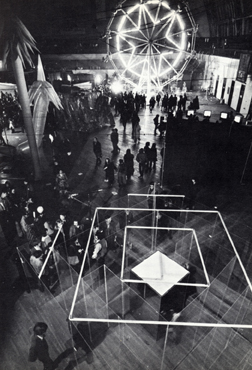
Electronic Arts Intermix festival at the 69th Regiment Armory in New York City
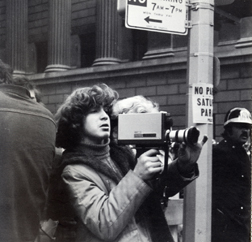
Teen-age participants in the New York Public Library's Video Workshop use equipment from the Media Equipment Resource Center.
Film, TV/Media, Literature
In 1970-71 the much enlarged legislative appropriation for the Council allowed initial support for television, video, and media projects as well as increased assistance in connection with film showings, filmmaking, poetry, and literature. The number and kinds of such activities made possible by Council support continued to increase and diversify in 1971-72.
In regard to film, it was a year when more people than perhaps ever before had opportunities to experience the medium's extraordinary variety through programming at centers that ranged from the Circle Film Forum and the Millennium Film Workshop to the Whitney Museum of American Art, and through organizations as varied as the Film Society of Lincoln Center, statewide public library systems, and the Plattsburgh Film Society. It was a year of unusually productive filmmaking achieved through the Media Equipment Resource Center.
It was a year when experimentation and exploration by independent video artists was freed from closed-circuit systems in out-of-the-way places and began to reach broad audiences by coaxial cable. The Council's activity as one of the few sources of aid for such research and development, and the growth of interest in TV's unexplored potential combined to increase requests for assistance far beyond its means, but commitment to independent television and public television continued in a substantial and significant manner.
It was a year in which public New York State appearances and workshop participation by writers and poets more than doubled as did the audiences for them, and one in which especially strong Council support was given to the imaginative work of the Teachers and Writers Collaborative and the St. Mark's Church In-the-Bowery Poetry Project. Small circulation magazines again received aid from the Council's grant to the Coordinating Council of Literary Magazines in 1971-72, rounding out a support program that affected both creative accomplishment in and broadened public acquaintance with the communication arts.
NYSCA 1971-72 Film Program Support
* means that the organization received support from at least one other program at NYSCA. The organizations receiving media support which received help for a media-related project from another program are listed following the Media listing.
The striking and sometimes startling diversity of our movies' past was made accessible to New Yorkers across the State in record magnitude this year as noncommercial film organizations sought to present examples of the best work done in the relatively brief (seventy-five-year) history of the medium--from early silent classics to the most recent films of contemporary artists. Recognizing the growth of audiences that are serious about movies, a few commercial movie houses also joined in this counter-thrust to prevalent practice and instituted repertory programming on the basis of lasting quality rather than immediate topicality.
A variety of Council grants played a major part in this development, making possible among other things the Ninth New York Film Festival, the First International Festival of Women's Films, and the year-round programs of the Circle Film Forum.
Throughout the State, library systems received grants to expand their collections of 16mm feature films, and three such systems shared their film collections to provide even greater diversity for their constituents. With encouragement from the Council-supported Greater Middletown Arts Council, the distinguished Bown Adams collection of silent films was projected for Middletown area audiences at the State Hospital and for senior citizens and high school students. In western New York, film enthusiasts had opportunities to see movies and hear filmmakers through a Council grant to Media Study, Inc. of Buffalo, and eminent teachers including Bruce Baillie, Stan Brakhage, Ed Emshwiller, Richard Leacock, and Stan VanDerBeek participated in "image making" workshops sponsored by the same group. In Rochester the International Film Festival--a critical success but in financial difficulty after its first year--was enabled to sustain activity.
At the same time, the Council continued support for the creation of films by grants to film workshops and by making film equipment available to community groups and institutions on free short term loan. Administered by the Young Filmakers' Foundation, the loan program (known as MERC--the Media Equipment Resource Center) has benefited more than a hundred organizations and individual filmmakers in the first nine months of its existence. With Council support, the Young Filmaker's Foundation continued to expand its varied media programs for young people, which have been models for organizations throughout the nation.
Through the Film Speakers Bureau, which provides schools, libraries, and film societies with matching funds up to $300 for rental of films and up to $150 for appearances by film speakers, the Council continued statewide support of educational activities to foster film appreciation. The Bureau's purview was expanded this year to include fees for artists working in video to demonstrate and speak about their work. Rental of videotapes also received partial support. A detailed report on Film Speakers Bureau activity follows the listing of film assistance.
Film assistance in 1971-72
The American Museum of Natural History, New York City. $25,000 for the development of a multiple-screen film by Francis Thompson on the worldwide environmental crisis.*
Bay Area Friends of the Fine Arts. Bayport. $300 for rental fees for an international film series.*
Brooklyn Arts and Culture Association (BACA). $1,830 for film stock and processing for teenage workshops in Bay Ridge and Bensonhurst.*
Center for Understanding Media, New York City. $13,600 for an expanded program of short films shown at the Children's Film Theater to study child reactions, and for a study of films being produced in secondary schools in New York State.
Chautauqua-Cattaraugus Library System, Jamestown. $17,951 for the salary of a film librarian, and for the expansion of a film rental program.
The Children's Art Carnival, New York City. $1,569 for teachers' salaries and operating costs of a young people's workshop in animation and still photography. The Carnival is sponsored by The Museum of Modern Art.*
Columbia County Council on the Arts, Chatham. $300 for the continuation of a community film series.*
The Community, A Free School, Willow. $3,000 for a teacher's salary, materials, and equipment rental for a children's film and video workshop.*
Council on the Arts for Clinton-Essex Counties, Plattsburgh. $300 for rental of feature-length and short films for the Plattsburgh Film Society.*
Earlville Opera House. $6,525 for the salary of a director and operating costs of a film and video workshop for teen-agers, adults, and senior citizens.*
George Eastman House, Rochester. $4,750 for a study and symposium on the effect of sound on the development of the film.*
Educational Film Library Association, New York City. $15,000 for the expansion of the statewide services of their film information center.
Everson Museum of Art, Syracuse. $700 for rentals for a film series and appearances by filmmakers.*
The Film Making Project, Babylon. $1,000 for the expansion of a Super-8 workshop for children, teenagers, and adults.
The Film Society of Lincoln Center, New York City. $38,500 lor production expenses for the ninth New York Film Festival and the 1971 season of Movies in the Park.
Film Speakers Bureau, New York City. $35,000 for a program providing matching funds for rental of films and videotapes and fees for lectures on video, films, and filmmaking presented at libraries, museums, and other community centers throughout the State.
Friends of the Lakeview Library, Rockville Centre. $325 for film rentals.*
Greater Middletown Arts Council. $1,600 for operating costs of a festival of classic silent films and a mobile film series presented at the Middletown State Hospital, the Area Nursing Home, and the Senior Citizen Center.*
The Solomon R. Ciiggenheim Museum, New York City. $2,000 for the salary of a curator to plan a three-week film retrospective and prepare an illustrated catalog of the program.*
Hamilton-Madison House, New York City. $2,500 for the continuation of a filmmaking workshop for young people.*
Henry Street Settlement, New York City. $14,450 for the salaries of a director and assistant director of filmmaking workshops for young children and teenagers.*
Hudson River Museum at Yonfeers. $7,000 for operating costs for the continuation of a filmmaking workshop for inner city teenagers.*
Institute of New Cinema Artists, New York City. $10,000 for administrative costs and the salary of a director of an apprenticeship program developed in cooperation with Third World Cinema Productions.
International Film Seminar, New York City. $1,050 for scholarships for students and teachers attending the annual Robert Flaherty Film Seminar.
Kenan Center, Lockport. $500 for a community film series.*
Kirkland Art Center, Clinton., $450 for an instructor's salary and for film stock and processing expenses for a children's workshop.*
The Loft Film and Theatre Center, Bronxville. $14,100 for staff salaries for a film workshop for young people, and for a Super-8 research project.
Emily Lowe Gallery, Hofstra University, Hempstead. $170 for film rentals for a community film series.*
Lyceum, Saranac Lake. $850 for the expansion of a film series for students and children at North Country Community College.*
Media Study, Inc., Buffalo. $20,493 for establishing a media center for Buffalo and western New York State including salaries of a director and a producer, fees for film and media artists-in-residence, and operating and equipment expenses; and for production expenses for a film presentation on the life and art of D. W. Griffith, produced and directed by Arthur Barren.*
The Metropolitan Area Council for International Recreation, Culture and Lifelong Education, New York City. $11,000 for the salary of a director of film programs, and for film rental fees at the Circle Film Forum.*
Mid-Hudson Libraries, Poughkeepsie. $11,000 for long-term leasing of feature films for the use of member libraries.
Mid-York Library System, Utica. $11,000 for longterm leasing of feature films for the use of member libraries, and for the expansion of a 16mm classic feature film collection.
Millbrook Community Center, East Side House Settlement, Bronx. $2,000 for instructors' salaries, and for film stock and processing expenses for a community filmmaking workshop.
Millennium Film Workshop, New York City. $20,000 for administrative salaries and filmmaker's fees for the continuation of a creative film workshop and public showings for new films.
Mohawk Valley Library Association, Schenectady. $7,500 for rental of films shown by member libraries and expansion of a 16mm film collection.
Grandma Moses Cultural Center, Hoosick Falls. $1,000 for film rentals, and for the salary of a director of a film series and seminar.*
Narcotics Education Workshop of Westbury. $5,000 for the salary of a film teacher and for film stock and processing expenses for the continuation of a young people's filmmaking workshop.
Nassau Library System, Garden City. $4,000 for long-term leasing of feature films.
New York University School of the Arts, New York City. $5,100 for administrative costs and for honoraria for student filmmakers participating in film seminars in six upstate communities.*
Nineteenth Ward Community Association, Rochester. $10,352 for salaries and for film stock and processing expenses for the continuation of a filmmaking workshop for inner city youth.
North Shore Community Arts Center, Great Neck. $400 for operating costs of a film series.*
The Alexander Robertson School, New York City. $525 matching funds for long-term leasing of films for the West Side Film Teachers Cooperative.
Rochester International Film Festival. $15,000 for administrative and fund raising expenses.
Sage Hill Camp, New York City. $600 for operating costs of summer film workshop activities.
South Shore Cultural Arts Center, Point Lookout. $1,100 for operating costs for the continuation of a filmmaking workshop.*
The Studio Museum in Harlem, New York City. $7,670 for the costs of a filmmaking workshop.*
Troy Pubic Library. $500 for film rentals for a children's film series.*
Upper Hudson Library Federation, Albany. $5,000 for operating costs for the continuatio.n of a film and videotape workshop for inner city youth.
Wantagh 7-12 Association. $2,000 for salaries and supplies for an artists-in-residence project.*
Westchester Library System, White Plains. $4,000 for the rental of feature-length films for the use of member libraries.
Whitney Museum of American Art, New York City. $4,800 for fees for filmmakers whose films were shown in the New American Filmmakers Series.*
Women's Interart Center, New York City. $7,500 for the salaries of a film workshop teacher and the director and coordinator of the First International Festival of Women's Films.*
Young Filmaker's Foundation, New York City. $92,575 for salaries and administrative costs of the Foundation's statewide programs; and for equipment and the salaries of a director and an assistant for the Media Equipment Resource Center.
Youth Film Distribution Center, New York City. $9,000 for the salaries of a director and a secretary to continue film distribution and arrange a young people's film festival.
YWCA of Buffalo and Erie County. $7,100 for salaries, film stock, and processing expenses for the continuation of the Channel of Soul film workshop.
YWCA of Peekskill. $1,500 for the salary of a parttime film teacher, film stock, and processing expenses for a workshop for young people.
Film and videotape rentals assisted in 1971-72 by the Film Speakers Bureau
Numbers following institution names indicate more than one instance of assistance.
Albany - Friends of the Albany Public Library
Annandale-on-Hudson - Bard College/2
Baldwin - South Shore YM-YWHA
Clifton Park - Clifton Park-Half moon Area Jaycees
Earlville - Earlville Booster Club
Florida - Synechia Arts Center
Huntington Station - Holy Family Diocesan High School
Nanuct - St. Agatha School
New Rochelle - Iona College
New York City - The Bernard M. Baruch College of the City University of New York/2; The Chapin School; The City College of the City University of New York/2; Hunter College of the City University of New York/2; The Lenox School; Movies in the Park/5; New York University Institute of Film and Television/2
Rhinebeck - Upstate Films
Rochester - The Harley School
Scotia - New York State Art Teachers Association/2
Wilson - Wilson Central Schools
Yorktown Heights - BOCES
Speakers' appearances arranged and assisted in 1971-72 by the Film Speakers Bureau
Numbers following speakers' names indicate multiple appearances at one institution.
Albany - Arbor Hill Community Center (/err/ Brace, Michael Rutherford, Cindy Stump, She/don Taylor); New York State Youth Film/Media Show (Patricia Bellantoni, Dan DiNicola, David lackier, lohn Lidstone)
Baldwin - South Shore YM-YWHA (Leonard Herman/8)
Binghamton - Experimental TV Center (Ange/ Nunez, Abby Schwartz/2)
Burnt Hills - Burnt Hills-Ballston Lake PTA Council (Dan DiNicola/7, Lorraine Madriska/2)
Chatham - Columbia County Council on the Arts (Fred Silva/3)
Earlville - Earlville Opera House (Howard Finch/2, Robert Oliver/2)
Middletown - Orange County Community College (DeeDee Halleck); Orange County Fair (Nancy Cain, Chris Emanuel/2, Linda Halcotf, DeeDee Halleck/2, Betty Kratzenstein)
New York City - The City College of the City University of New York (Ernie Gehr); The New York Public Library Video Workshop (Bill Sloan/8); New York University (Charlotte Moorman/3); New York University Institute of Film and Television (Stan Brakhage, Hollis Frampton, Ernie Gehr, Michael Snow); Public Access Celebration (Tom Bigornca, Mike Frank, Steve Fuller, Howie Gutstadt, Mollie Hughes, Phyllis Johnson, Phoebe Kaylor, Ben Levine, Charles Levine, lames Smith, Bill Stevens); Women's Interart Center (Susan Kleckner/3)
Woodstock - Whiz Bang Quick City (Ralph Arlych/2)
Yorktown Heights - BOCES (Vincent Clarkin/4)
NYSCA 1971-72 Annual Report TV/Media Funding
* means that the organization received support from at least one other program at NYSCA. The organizations receiving media support which received help for a media-related project from another program are listed following the Media listing.
TV/Media
In 1971-72 the Council continued its previous encouragement of the growth of what has been called "video literacy," enabling workshops throughout the State to provide training for artists and community groups in the use of portable videotape systems as a medium for expression and communication. The diversity of groups receiving such assistance in itself suggests new and effective uses for the video medium, and several have now directed their energies toward programming for cable television, particularly through the public access channels provided by New York City's two franchised cable companies. National attention is focused on these channels as models on which municipal regulation of cable television might ultimately be based.
Council support to public television this year aided in the creation of a thirteen-week arts series called Carousel, with each weekly component originating in a different part of the State. The series also served to link the seven member stations of the New York Network in their first major cooperative enterprise, with each station receiving funds for the production of one or more half-hour color programs and all stations presenting the entire series.
The Artist's Television Workshop at WNET, Channel 13 in New York City, founded in 1970-71 with Council support and subsequently expanded with a grant from the Rockefeller Foundation to become the experimental Television Laboratory, received continued Council support in 1971-72 in response to artists' interest in access to sophisticated color television facilities and the station's desire to enrich broadcast television.
TV/Media assistance in 1971-72
American Crafts Council, New York City. $2,800 for video installations at crafts exhibitions and maintenance of video equipment.*
The Block of 7th Street Media Project, New York City. $19,986 for continuation of media workshops, an afternoon program for teen-agers, videotape and equipment expenses, assistance in fund raising, and salaries of one coordinator, three associate coordinators, and three junior associates.
Broadway Local, New York City. $2,000 for portable video equipment for community events.
The Brooklyn Museum. $6,000 for a feasibility study of museum arts programs for public television.*
Center for the Study of Social Change, New York City. $25,000 for a videotape documentary and a written report on the development of video as a means of social expression and as a creative art form.
Cornell University, Collaborations in Art, Science and Technology, llhaca. $20,000 for continuation of art and technology programs and a multimedia poetry tour, cable TV productions, general administration, and the salary of a director.
Educational Broadcasting Corporation (WNET, Channel 13) New York City. $69,200 for continuation of the Artist's Television Workshop as the experimental Television Laboratory including equipment expenses and salaries of an administrator-technician and artist-in-residence Nam June Paik, and for program production for the Council-sponsored Carousel series.
The Educational Television Council of Central New York (WCNY, Channel 24), Syracuse. $26,350 for program production for the Council-sponsored Carousel series including the series opening, closing, and transitional sequences, and for a helical scan color videotape recorder for duplication of Council-supported programs and general studio
Electronic Arts Intermix, New York City. $35,300 for salaries and equipment expenses for three multimedia programs.
Experimental Television Center, Binghamton. $12,248 for the design and construction of the Paik-Abe video synthesizer for use by public television stations and individual video artists. Experiments in Art and Technology, New York City. $4,550 for production of thirteen half-hour experimental videotape programs for public access television.
The Finch College Museum of Art, New York City. $10,160 for salaries of video photographers and a projectionist, artist honoraria, and travel, equipment, and videotape expenses for a six-week videotape exhibition.
Global Village Video Resource Center, New York City. $15,000 for continuation of community- oriented video workshops, salaries of two consultants and four production assistants, equipment expenses, and editing facilities for community groups.*
Intermedia Institute, New York City. $40,000 for eight productions in an evening multimedia series involving electronic music, computer films, videotape, and video projection, and for the salaries of a director and an administrative assistant.
Long Island Educational Television Council (WLIW, Channel 21), Garden City. $21,350 for program production for the Council-sponsored Carousel series, and for a helical scan color videotape recorder for duplication of Council-supported programs and general studio use.
Media Bus, Lanesville. $15,000 for continuation of a mobile community video workshop in upstate New York, and for salaries of artist-technicians.*
Media Study, Inc., Buffalo. $12,643 for establishing a media center for Buffalo and western New York State including salaries of a director and a producer, fees for film and media artists-in-residence, and operating and equipment expenses.*
The Metropolitan Museum of Art, New York City. $16,453 matching funds for the production of a pilot color broadcast videotape program on the Museum's collections.*
Mohawk-Hudson Council on Educational Television (WMHT, Channel 17), Schenectady. $21,350 for program production for the Council-sponsored Carousel series, and for a helical scan color videotape recorder for duplication of Council-supported programs and general studio use.
New School for Social Research, New York City. $14,700 for a report on the feasibility of live production neighborhood facilities for cable television, prototypes of software to be produced in cooperation with Global Village Video Resource Center, and equipment expenses.
New York University, The Media Co-op, New York City. $5,000 for honoraria, transportation, salaries of a director and six aides, and thirty hours of videotaping, editing, and copying in connection with a conference to build community participation in media.
Open Channel, New York City. $14,000 for community consultants and videotape and equipment expenses to support a community cable television facility in New York City.
People's Video Theatre, New York City. $18,000 for continuation of community television programming, and for salaries of three video directors, a video technician, and an administrator.
Port Washington Public Library. $14,000 for the continuation of an experimental project in the community use of media including the salaries of the project director and a special project facilitator.
Priority One of Greater Syracuse. $3,000 for continuation of multimedia productions dealing with community issues.
The Raindance Foundation, New York City. $19,500 for continuation of the quarterly Radical Software, community programs for cable television, and the salaries of five staff members.
Rochester Area Educational Television Association (WXXI, Channel 21), Rochester. $21,350 for program production for the Council-sponsored Carousel series, and for a helical scan color videotape recorder for duplication of Council-supported programs and general studio use.
Rochester Museum and Science Center. $15,000 for continuation of a video equipment pool including administrative costs, overhead, salaries, tape, equipment, and maintenance.*
Sonic Arts Union, Stony Point. $5,000 for continuation of multimedia concerts.*
Southern Tier Educational Television Association (WSKC, Channel 46), Binghamton. $21,350 for program production for the Council-sponsored Carousel series, and for a helical scan color videotape recorder for duplication of Council-supported programs and general studio use.
The Space for Innovative Development, New York City. $38,400 for salaries of a director-administrator and a production director for the Space Videoarts division, general administration, a pilot project in non-urban cable television to be conducted by Paul Ryan as artist-in-residence, and equipment and production expenses.*
Elaine Summers Experimental Intermedia Foundation, New York City. $14,000 for continuation of experimental intermedia productions and for video experimentation in dance and theatre.* Supernova of the Arts, New York City. $14,000 for continuation of workshops in photography, silk screen, poetry, sound, and children's art, and for general administration and supplies.
The United Presbyterian Church, Division of Mass Media, New York City. $6,750 for ten trainees participating in cable television workshops, sponsored by the Office of Cultural Minority Programming.
Video Access, New York City. $6,300 for videotaping multimedia workshops organized by the Museum of the City of New York, salaries of a video program director and an assistant, and equipment expenses.
Visual Studies Workshop, Rochester. $15,000 for artists' fees for the continuation of a visiting artists multimedia program, and for the establishment of a research center with a library of audiotapes, films, and videotapes.*
Western New York Educational Television Association (WNED. Channel 17), Buffalo. $21,350 for program production for the Council-sponsored Carousel series, and for a helical scan color videotape recorder for duplication of Council-supported programs and general studio use.
NYSCA 1971-72 Support for Media Projects from Other Programs
[The listings under each program area are selected from the NYSCA final report. We have not included projects where it was not clear that media was integrated into the project, or where media was used solely as an informational or documentary technique or a transmission medium for another art form. Some of the descriptions have been excerpted, indicated by brackets; activities which were not media-related may be omitted.]
Performing Arts Presenting Organizations
The Buffalo Fine Arts Academy. $2,500 for artist fees for performances by the Nikolais Dance Theatre, the S.E.M. Ensemble (experimental electronic, instrumental and audiovisual works), and the Buffalo Philharmonic Orchestra (a new work by Lukas Foss to celebrate the tenth anniversary of the Albright-Knox Art Gallery) .
Performing Arts Dance
Mimi Garrard Dance Theater Company, New York City. $1,500 for administrative expenses and fees for dancers and stagehands for a dance-theatre-media concert at Stony Brook.
Video Exchange, New York City. $7,500 for editing and marketing tapes of performances by thirty-eight different dancers and dance companies.
Performing Arts Theater
The Jugglers, New York City. $2,500 for production expenses for a series of performances of a multimedia work for children, and for development of a new work.
The Touchstone Center for Children, New York City. $2,700 for production expenses for the completion of Dream Project, a participatory theatre piece for children combining improvisation, poetry, artwork and film.
Special Programs
Special Programs was developed by the Council in response to assistance requests from arts organizations serving predominantly black and Puerto Rican audience groups. In 1967, when the Council first allocated funds for such purposes, an emergency situation had been recognized in ghetto areas, where expression was either undeveloped or stilled. Service agencies tended to look at the first ghetto arts programs as "cooling" devices, but the talent and artistic expression that emerged from them soon made a real impact on the broader culture. Now the experience gained as Special Programs helped ghetto culture come into its own has also started to find application within the larger society.
Special Programs has not only encouraged professional black, Puerto Rican, Asian-American, and American Indian artists to practice and exhibit their art, although that has been a large part of its accomplishment. Concurrently, it has worked to develop the cultural resources of ghetto communities through nonprofessional participation in the creative processes that relate art to the everyday life of the ghettos. More recently the techniques developed in this latter sphere of activity have been used to liberate frustrated voices in other cultural communities previously thought to be barren. Special Programs activities for 1971-72 remained strong in the black and Puerto Rican neighborhoods, but it extended itself to also encompass rural towns, Indian reservations, suburban areas, migrant camps, hospitals, prisons, and other ethnic communities as well. One major vehicle for providing seed grants for the development of arts resources within isolated cultural communities - now organized as The Isolated Communities Program - is administered by The America the Beautiful Fund of New York under matching funds from the Council and the National Endowment for the Arts. The activities of this program are reported separately at the end of other Special Programs grant listings.
The past year witnessed impressive growth of community-based arts organizations emerging throughout the State with Special Programs assistance. Because these are often unique regional resources they tend to serve and minor a complex of cultural demands so that a single organization may sponsor street theatre and operate mobile units in dance, sculpture, and film. A new kind of multi-arts community artist has developed within several such groups with Special Programs encouragement. With full professional stature and broad artistic recognition in hand, these artists maintain their community ties and put their abilities to work variously in the interest of community expression.
One further 1971-72 Special Programs development merits special attention here - the recognition of cooperative arts efforts within black and Puerto Rican communities. Typical of these were the theatre festival sponsored by the Black Theatre Alliance and a dance festival sponsored by The Manhattan Theatre Club. Many of the participating groups, which originated with the sole support of the Council, have gone on to find financial assistance elsewhere in relation to their established worth. Special Programs continues to contribute to such groups by paying for specific public performances.
Amas Reportory Theater, Bronx. $17,000 for administrative and production expenses for this multiracial theatre company which provides workshop instruction in music, dance, drama, filmmaking and playwriting.
A.P.S. Creative Arts Center, Buffalo. $15,000 for free workshops in drawing, painting, graphic design, photography, and film at the Langston Hughes Center for the Visual and Performing Arts.
Arts Inc., New York City. $15,000 for workshops in drama, dance, music, printmaking, calligraphy, graphic design and reproduction, still photography, and filmmaking for teachers, students and community workers in Lower Manhattan.
Black and White Action, Williamsville. $7,500 for production expenses for a black literature seminar, a jazz festival for youth, a movie festival and three dramas presented in the Buffalo inner city and suburbs.
Cultural Council Foundation, New York City. $50,500 for operating costs of a black film festival presented without charge at locations throughout the five boroughs of New York City. (excerpted).
Global Village Video Resource Center $5,000 for operating costs of a program of video instruction for community groups.
The Solomon Guggenheim Museum, New York City. $10,000 matching funds for fees of instructors for a program of free professional instruction in art, dance, filmmaking, music, theater, photography and graphics for approximately one hundred inner city children.
Hamilton Hill "Drop-in" Arts and Crafts Center, Schenectady. $14,000 for arts, crafts and film workshops; and for trips and summer programs.
Special Programs Isolated Communities Program
American Life Foundation, Watkins Glen. $1,500 for a community art center, a weaving workshop, a film festival and local crafts exhibits.
Bellevue Hospital Center, New York City. $600 for a workshop in elementary and intermediate printmaking; and $1,020 for a photography and video workshop.
Center for the Arts at Ithaca. $1,920 to produce a series of cable TV programs on local history and culture.
Friends of the East Islip Public Library. $1,500 to record the history of the area by audio- and videotapes of senior citizens.
North Country Cultural Center, Warrensburg. $5,000 for workshops in photography, video and visual arts for children and adults, and for special events to involve more people in creative activities.
Ogdensburg Public Library. $1,500 for a tape and film workshop to record the historical and cultural relationship between the town and the St. Lawrence River.
Visual Arts: Community Projects
Media Bus, Lanesville. $12,420 for administrative expenses and materials for introducing historians, designers, planners and architects to video methodology.
The Meadow Lane Players, Brookhaven. $6,000 for operating costs of a summer program of experiments involving marionettes, puppets and videotape, and performances in central Long Island shopping and community centers.
Regional Economic Community Action Program, Middletown. $8,700 for operating costs of the Live Arts program of film, crafts, theater and art workshops.
Visual Arts
The Farmer's Museum, Cooperstown. $56,890 for a summer seminar of mixed media techniques for teachers, media specialists, local historians and museum personnel to develop exhibitions about local environment;
Visual Arts Community Projects
Media Bus, Lanesville. $12,420 for administrative expenses and materials for introducing historians, designers, planners and architects to video methodology.
The Elaine Summers Experimental Intermedia Foundation, New York City. $3,000 for production expenses, including professional fees for a multimedia environmental event at the Seagram Building in New York City, coordinated by dancer Marilyn Wood.
Visual Arts Visiting Artists
"…Fifty-six artists and critics made 75 visits to 28 organizations in 1971-72. In addition, the Visiting Artists program cooperated with the Office of University-Wide Services of the State University of New York in a program which enables students throughout the State to visit artists' studios and galleries in New York City. Jan van der Marck, curator and critic, arranged for such Art Scene visits with Ivan Karp, Alex Katz, Tom Lloyd, Meredith Monk, Nam June Paik, Robert Smithson, Bernar Venet and Tom Wesselmann." [Excerpted.]
Cite this record
New York State Council on the Arts. New York State Council on the Arts Annual Report 1971-72. 1972.
Download RIS citationSummary
From the New York State Council on the Arts annual report 1971-72: a much enlarged 1970-71 legislative appropriation enabled initial Council support for television, video and media projects and increased assistance for film showings, filmmaking, poetry and literature; support broadened and diversified in 1971-72. The report notes productive filmmaking at the MediaEquipmentResourceCenter and independent video reaching audiences by coaxial cable; writers' public appearances and workshops more than doubled with Council support for the Teachers and Writers Collaborative and St. Mark's Church In-the-Bowery Poetry Project, and a 1971-72 grant aided small circulation magazines via the Coordinating Council of Literary Magazines; entry signed Peter Bradley.
Submit a change or correction
Last modified 13 September 2026