Paik/Abe Colorizer - Experimental Television Center Studio System Manual
PAIK/ABE COLORIZER
The Paik Abe input structure allows manual mixing of up to 7 video signals. The mix is applied to the three inputs of a color encoder, then passed through an output amplifier.
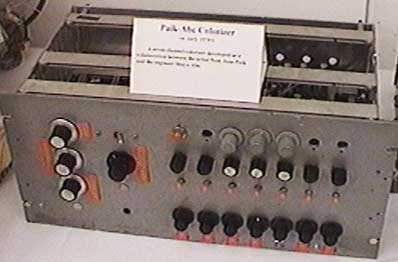
Panel controls for each input channel include a gain pot, an on/off switch and color mixing controls. The color mixing controls direct the video into one or two of the encoder inputs. Channels with selector knobs allow a choice of input to one encoder input or a pan into two inputs. Starting counterclockwise the choices are Red, Green, Blue, R-G, R-B, G-B. On certain Paik Abe colorizers there are only five choices, with one of the mix choices omitted. However, all combinations are available using all three switchable channels.
It is important to note that these color designations are all relative to the HUE control on the output amplifier and will only hold relative relationships to each other. That is why the panel is not marked according to color.
The pan pot allows the signal to be panned into the two selected encoder inputs. Naturally if the selector is set to a one-input position, first three, then the pan pot is nonfunctional. On channels without a selector switch, a fixed pan selection has been made.
The Paik Abe does an additive mix, combining signals such that all portions of each signal reach the output. The images appear on top of each other, or superimposed. That is why the Paik Abe is sometimes referred to as a mixer. The inputs are sensitive, and a wide range of effects is obtained with a sweep of the input gain control. Sometimes a signal with enough gain will become negative. Key-like effects may appear. To get a feel for the machine, use all the knobs and go slowly.
There are no voltage control inputs on the Paik Abe. It is a manual device. However, inputs can first be passed through video VCAs and the output can be processed through other voltage controlled processors in the system.
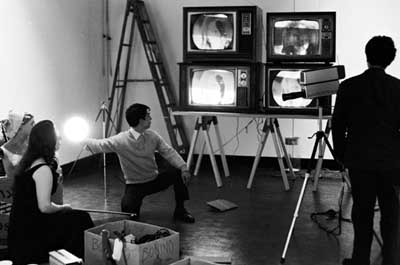
Charlotte Moorman and Shuya Abe, 1971
photograph by Evangelos Dousmanis
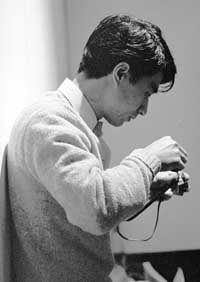
Shuya Abe, 1971
photograph by Evangelos Dousmanis
Early Paik/Abe Colorizer
photography by Pamela Hawkins
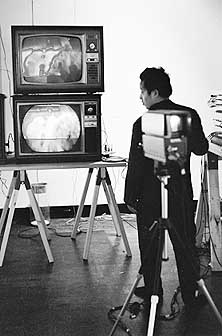
Nam June Paik at Bonino Gallery
photograph by Evangelos Dousmanis
Cite this record
Sherry Miller Hocking; Brewster, Richard; Peer Bode; Hank Rudolph; Matthew Schlanger. Paik/Abe Colorizer - Experimental Television Center Studio System Manual. 1980,1986.
Download RIS citationSummary
The Paik/Abe Colorizer is a manual video mixer combining up to seven video signals into the three inputs of a color encoder and routing the output through an amplifier; channel controls include gain pots, on/off switches, color selectors and pan pots. Selector positions include Red, Green, Blue, R-G, R-B and G-B; the unit performs additive mixing, is sensitive to input gain (producing key-like or negative effects), has no built-in voltage control inputs (external video VCAs and voltage-controlled processors can be used). Photographs by Evangelos Dousmanis and Pamela Hawkins document Charlotte Moorman, Shuya Abe (1971), an early Paik/Abe Colorizer and Nam June Paik at Bonino Gallery.
Submit a change or correction
Last modified 13 September 2026