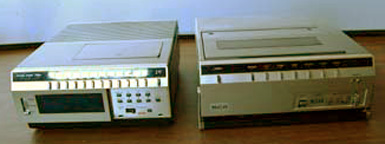
RCA SelectaVision VCR
RCA SelectaVision VCR
The first Betamax video cassette recorder was introduced in the US in 1976 by Sony. The system was marketed to encourage consumers to record television programs off the air, for later viewing. Sony was sued by Disney and Universal on the basis of copyright infringement. In 1984 the U.S. Supreme Court ruled that home taping of copyrighted works was included under the "fair use" exception to copyright.
In October 1977, RCA introduced its SelectaVision Video Cassette system, produced by Matsushita and based on the VHS format, incompatible with Betamax. The machine offered a two hour and four hour recording modes, while the Betamax system offered only 1 hour.
RCA marketed the machine with prerecorded sports programming and a large marketing and promotion campaign. By 1979 VHS format was outselling Betamax by a margin of 2 to 1.
Summary
Sony introduced the first Betamax video cassette recorder in the US in 1976; the system was marketed to encourage consumers to record television programs off the air, and Sony was sued by Disney and Universal, with the U.S. Supreme Court ruling in 1984 that home taping fell under the fair use exception. In October 1977 RCA introduced its SelectaVision Video Cassette system, produced by Matsushita and based on VHS; it was incompatible with Betamax and offered two-hour and four-hour recording modes while Betamax offered one hour. RCA marketed SelectaVision with prerecorded sports programming and a large promotion campaign; by 1979 VHS outsold Betamax by 2 to 1.
Submit a change or correction
Last modified 13 September 2026